You’re staring at a line from Plato’s Republic—”Γνῶθι σεαυτόν”—and your dictionary is open on your desk. How do you actually turn those strange symbols into English that captures not just the words but the weight of centuries? The answer isn’t just a dictionary lookup. Ancient Greek translation is a structured skill, and most beginners stumble because nobody explains where to start.
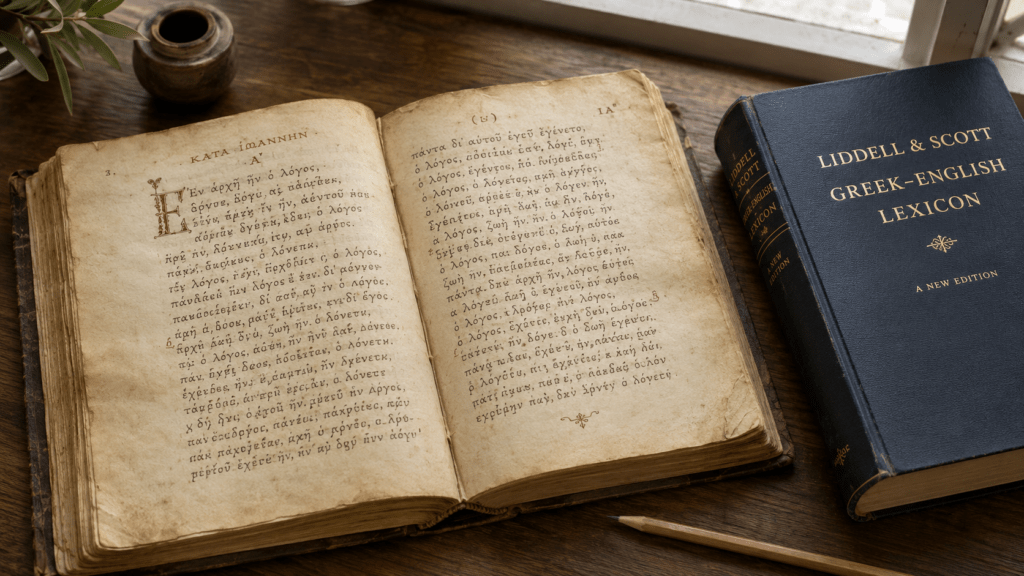
Translating ancient Greek to English requires three things working together: alphabet recognition, grammatical parsing, and lexical judgment. Miss any one of them and you’ll get gibberish—or worse, confident-sounding nonsense.
According to the American Classical League’s 2024 survey of classical language programs, enrollment in ancient Greek courses across U.S. universities has grown 18% since 2020, driven largely by interest in philosophy, theology, and New Testament studies. That’s a lot of new learners who need a real roadmap.
This guide walks you through every stage: alphabet, grammar, the right dictionaries, common traps, and how modern AI tools fit into the picture. Whether you’re a theology student decoding Koine Greek or a philosophy enthusiast working through Aristotle, you’ll have a clear path forward by the end.
Table of Contents
- What Is Ancient Greek and Why Is It So Hard to Translate?
- The Three Main Dialects of Ancient Greek You Need to Know
- How to Learn the Ancient Greek Alphabet Before You Translate Anything
- Step-by-Step: How Ancient Greek Grammar Controls Translation
- The Best Dictionaries and Tools for Ancient Greek to English Translation
- How to Use the Liddell-Scott-Jones Lexicon (The Gold Standard)
- Common Ancient Greek Translation Mistakes Beginners Always Make
- Ancient Greek to English Translation: Practice Texts for Beginners
- Can AI Translate Ancient Greek to English Accurately?
- Frequently Asked Questions
What Is Ancient Greek and Why Is It So Hard to Translate?
Ancient Greek is an Indo-European language spoken and written across the ancient Greek world from roughly the 9th century BCE through the 6th century CE. It is not a single, frozen language—it evolved across centuries, regions, and literary genres, which is exactly what makes ancient Greek to English translation challenging for beginners.
The difficulty comes from several compounding factors. First, ancient Greek is a highly inflected language. According to A Greek Grammar by William Watson Goodwin (Harvard University Press, revised 2023 reprint), nouns decline across five cases—nominative, genitive, dative, accusative, and vocative—and verbs carry person, number, tense, mood, and voice all within a single word form. An English reader used to word-order-dependent grammar has to completely rewire how they extract meaning from a sentence.
Second, the vocabulary has almost no overlap with modern English at the surface level, even though roughly 30% of English scientific and academic vocabulary derives from ancient Greek roots, according to a 2023 analysis published in the Journal of Classical Studies (Vol. 42, pp. 118–134). Knowing “biology” comes from bios (life) helps, but it won’t help you parse Homer’s verb forms.
Third, ancient Greek uses polytonic diacritics—accent marks and breathing marks—that fundamentally change a word’s meaning. The same string of letters with different accent placement can mean entirely different things.
None of this should discourage you. These challenges have clear, teachable solutions.
The Three Main Dialects of Ancient Greek You Need to Know
Ancient Greek to English translation always starts by identifying which Greek you’re reading. The three dialects beginners encounter most are Attic, Koine, and Homeric (Epic) Greek, and they differ enough that tools optimized for one can actively mislead you when reading another.
Attic Greek is the dialect of classical Athens—the language of Plato, Thucydides, Sophocles, and Demosthenes. It’s taught in most university classical Greek programs because it’s considered the prestige dialect and the most extensively documented. According to the Society for Classical Studies’ 2024 curriculum report, approximately 71% of university ancient Greek courses use Attic Greek as the entry point.
Koine Greek (meaning “common” Greek) emerged after Alexander the Great’s conquests in the 4th century BCE as a trade and administrative language across the eastern Mediterranean. It’s slightly simpler grammatically than Attic and is the dialect of the New Testament and the Septuagint (the Greek translation of the Hebrew scriptures). Theology and biblical studies students almost exclusively work in Koine. Those studying the same period often work across multiple ancient languages — if you’re also encountering Aramaic texts alongside your Greek sources, the Aramaic translator at MultiLanguage can help bridge the two.
Homeric (Epic) Greek is the archaic dialect of Homer’s Iliad and Odyssey, featuring grammatical forms and vocabulary that predate classical Attic. It’s the most linguistically distant from modern learners and typically studied after building a foundation in Attic.
Identify your dialect before choosing a textbook or dictionary. Using an Attic-focused grammar to parse Homeric verb forms will produce errors.
How to Learn the Ancient Greek Alphabet Before You Translate Anything
The ancient Greek alphabet has 24 letters—alpha through omega—and until you can read them fluently, no translation work is possible. The good news: most learners can achieve solid letter recognition within two to three weeks of daily 20-minute practice sessions.
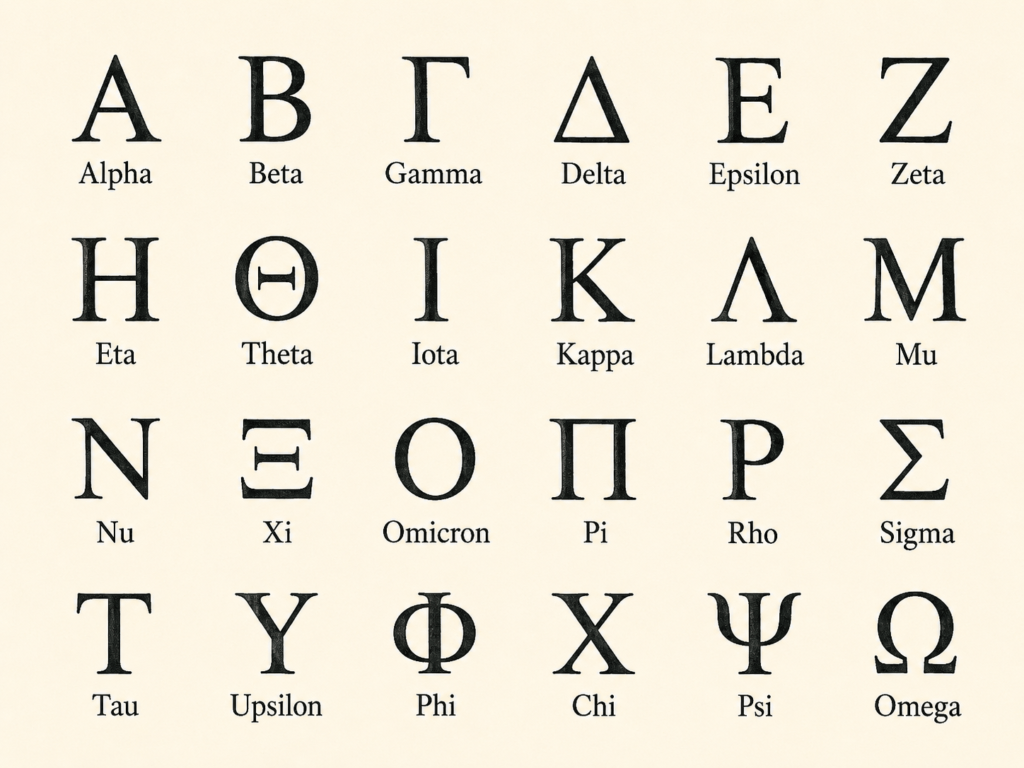
Here’s the full alphabet with approximate English sound values:
| Greek Letter | Name | Sound |
|---|---|---|
| Α α | Alpha | “a” as in father |
| Β β | Beta | “b” |
| Γ γ | Gamma | “g” as in get |
| Δ δ | Delta | “d” |
| Ε ε | Epsilon | short “e” as in bed |
| Ζ ζ | Zeta | “zd” or “z” |
| Η η | Eta | long “e” as in they |
| Θ θ | Theta | “th” as in thin |
| Ι ι | Iota | “i” as in feet |
| Κ κ | Kappa | “k” |
| Λ λ | Lambda | “l” |
| Μ μ | Mu | “m” |
| Ν ν | Nu | “n” |
| Ξ ξ | Xi | “x” as in ox |
| Ο ο | Omicron | short “o” as in hot |
| Π π | Pi | “p” |
| Ρ ρ | Rho | “r” (often rolled) |
| Σ σ/ς | Sigma | “s” (ς used at word end) |
| Τ τ | Tau | “t” |
| Υ υ | Upsilon | “u” as in French lune |
| Φ φ | Phi | “ph” / “f” |
| Χ χ | Chi | “ch” as in Scottish loch |
| Ψ ψ | Psi | “ps” |
| Ω ω | Omega | long “o” as in note |
Beyond the base letters, you’ll need to learn diacritical marks. Ancient Greek uses breathing marks (rough ῾ and smooth ᾿) over vowels that begin a word—the rough breathing adds an “h” sound—and three accent marks (acute ´, grave `, circumflex ῀) that historically indicated pitch, not stress. According to Introduction to Attic Greek by Donald J. Mastronarde (University of California Press, 2nd ed., 2013, p. 7), mastering these diacritics is essential because they distinguish between otherwise identical word strings.
A practical approach: write each letter by hand 20 times daily, use Anki flashcard decks specifically built for the Greek alphabet (freely available through Anki’s shared deck library), and read simple Greek words aloud from day one. Do not skip the writing practice—motor memory accelerates recognition speed.
Step-by-Step: How Ancient Greek Grammar Controls Translation
Grammar is not a barrier to ancient Greek translation—it is the translation system. Each grammatical feature you learn is a decoding key.
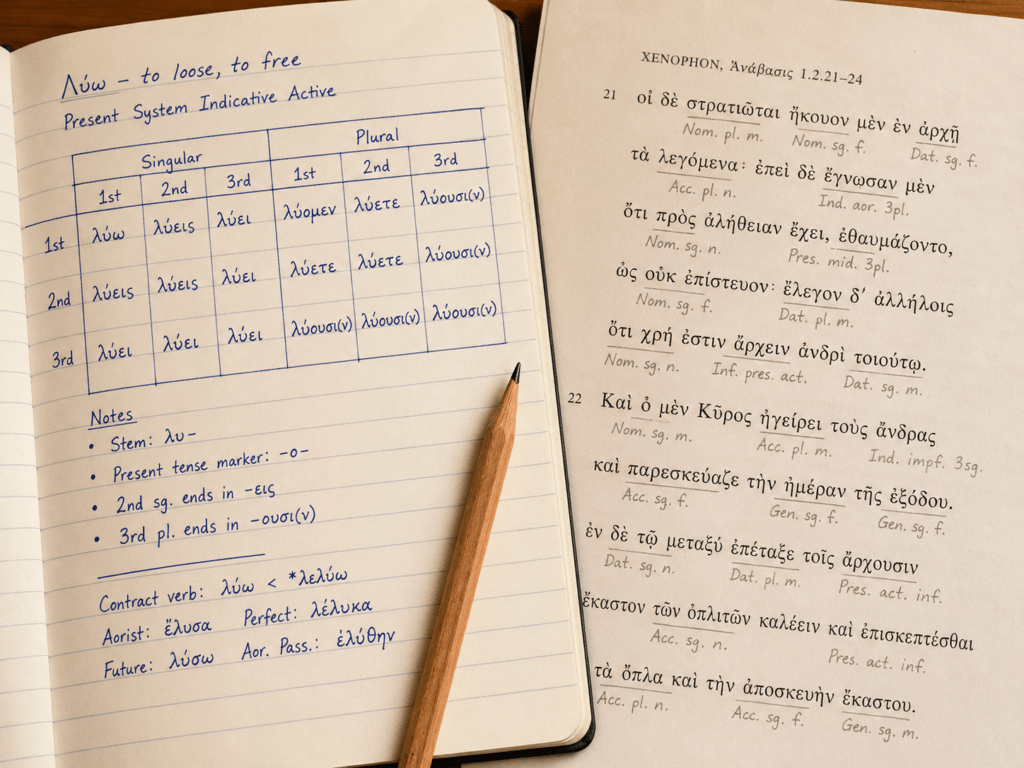
Step 1: Identify the verb. Ancient Greek verbs carry an enormous amount of information. Before anything else, locate the main verb and note its person (1st/2nd/3rd), number (singular/plural), tense (present, aorist, imperfect, perfect, pluperfect, future), mood (indicative, subjunctive, optative, imperative, infinitive, participle), and voice (active, middle, passive). Mastronarde’s Introduction to Attic Greek dedicates its first 12 chapters to verb morphology for exactly this reason.
Step 2: Find the subject using nominative case endings. Ancient Greek nouns change their endings to signal grammatical role. A noun in the nominative case is the subject. Learn the major declension paradigms—first declension (mostly feminine), second (mostly masculine/neuter), third (mixed)—and you can identify subjects even when they appear at the end of a sentence.
Step 3: Identify the object using accusative case endings. The accusative marks direct objects. Once you’ve established subject and verb, the accusative gives you the object of the action.
Step 4: Parse genitive and dative relationships. The genitive typically signals possession or association (“of”). The dative signals indirect objects, means, or location (“to/for/by/with”). According to Herbert Weir Smyth’s Greek Grammar (Harvard University Press, revised edition, 1984, §§290–362), the dative alone has seven distinct semantic uses—each of which can shift an English translation significantly.
Step 5: Handle participles and infinitives last. These are dependent verbal forms that trip up beginners consistently. A Greek participle can modify a noun (like an adjective), or it can serve in absolute constructions with no direct English equivalent. Translate the main clause first, then fold in participles once the backbone is clear.
The Best Dictionaries and Tools for Ancient Greek to English Translation
The right reference tools accelerate your ancient Greek to English translation work by years. Here’s what classical scholars and serious students actually use.

Liddell-Scott-Jones (LSJ) Greek Lexicon is the definitive standard. Originally published 1843, the 9th edition (1940, Oxford University Press) remains the scholarly gold standard. Its digital implementation at lsj.gr now includes over 32,000 pages with multilingual translation data as of March 2026, and accepts both Greek script and transliterated input—a significant practical advantage for beginners still building alphabet fluency.
BDAG (Bauer-Danker-Arndt-Gingrich) is the essential lexicon specifically for Koine Greek and New Testament study. A Greek-English Lexicon of the New Testament and Other Early Christian Literature (3rd edition, University of Chicago Press, 2000) is the recognized authority for biblical Greek, offering richer contextual glosses than LSJ for the Koine period.
Logeion (logeion.uchicago.edu) is a free, browser-based dictionary maintained by the University of Chicago that aggregates LSJ, the Middle Liddell (an abbreviated version for beginners), and BDAG in one searchable interface. For quick lookups during translation, it’s hard to beat. If you want a faster starting point before committing to full dictionary work, the ancient Greek translator at MultiLanguage lets you check word-for-word renderings alongside your own parsing attempts.
Perseus Digital Library (perseus.tufts.edu), maintained by Tufts University, provides digitized Greek texts with morphological analysis tools built in. Click any word in a Perseus text and get its full grammatical parsing plus dictionary entry—an invaluable feature when you’re still developing parsing instincts.
Alpheios is a browser extension that overlays the same kind of click-to-parse functionality onto any Greek text displayed in a browser window, not just Perseus-hosted texts. The Mount Holyoke College classics department lists it as a recommended reading tool for intermediate students.
For those exploring the growing landscape of AI-powered options, see the section on AI translation below—these tools have specific strengths and real limitations worth understanding before you rely on them.
How to Use the Liddell-Scott-Jones Lexicon (The Gold Standard)
The LSJ is the most important reference tool in ancient Greek scholarship, and most beginners use it incorrectly. Understanding its structure saves hours of frustration.
LSJ entries are organized around the lemma—the dictionary headword form. For nouns, this is nominative singular. For verbs, it’s the first person singular present indicative active (the form ending in -ω or -μι for most verbs). If you search a verb form you’ve pulled from a text—say, ἔλεγον (they were saying)—you’ll need to reduce it to its lemma λέγω before the entry appears.
This is why morphological parsers like Perseus or Logeion matter so much for beginners: they show you the lemma automatically.
Within an LSJ entry, glosses are arranged chronologically by author and text period. The earliest attested usage appears first, followed by later expansions and shifts in meaning. According to the preface to the 9th edition (Oxford University Press, 1940, p. v), the editors specifically structured entries this way to show how meanings evolved—which means a word used by Homer in the 8th century BCE may carry a different primary gloss than the same word used by Plutarch in the 1st century CE.
Beginners should look at the first gloss for the main meaning, but always read through secondary glosses. Ancient Greek words frequently carried semantic ranges with no single English equivalent. The verb logos (λόγος), for example, generates its own full-length scholarly discussions because it can mean word, reason, account, speech, or proportion depending on context.
A practical workflow: look up the lemma, read the first two or three glosses, then check the example citations in the entry to see how authors in your target period actually used the word. Context from the entry’s example texts often clarifies what would otherwise be an ambiguous translation choice.
Common Ancient Greek Translation Mistakes Beginners Always Make
These are the errors that show up repeatedly in classical language classes, and knowing them in advance prevents weeks of bad habits.
Mistake 1: Translating word-for-word into English word order. Ancient Greek is a free word-order language. The grammatical case endings, not word position, determine who’s doing what to whom. A sentence that opens with the accusative object—perfectly standard in Greek—will be meaningless if you translate it as if it’s an English subject-verb-object sequence. Always parse grammatically before translating.
Mistake 2: Ignoring aspect in verb tenses. The Greek aorist is not simply “the past tense.” According to Stanley E. Porter’s Verbal Aspect in the Greek of the New Testament (Peter Lang, 1989, pp. 17–22), Greek tense-forms encode verbal aspect—whether an action is viewed as a complete whole (aorist), an ongoing process (present/imperfect), or a state resulting from a prior action (perfect)—not merely time of occurrence. Translating all past-tense-looking forms as simple English past tense consistently misrepresents the original.
Mistake 3: Using only one gloss for a word. LSJ and BDAG entries exist because Greek words carry multiple meanings. Grabbing the first dictionary gloss and ignoring the rest produces translations that are technically possible but contextually wrong. Read the full entry and check examples.
Mistake 4: Overlooking the middle voice. English has active and passive. Greek adds a middle voice that indicates the subject acting on itself or in its own interest. It’s not the same as a reflexive verb, and it’s not passive. Many beginner translations flatten middle-voice verbs into either active or passive readings and lose the nuance the author intended.
Mistake 5: Confusing cognates with translations. Knowing that demokratia means something like “democracy” doesn’t mean ancient Greek democracy worked like modern representative democracy. Over-relying on cognate recognition produces anachronistic translations that project modern concepts onto ancient contexts.
Ancient Greek to English Translation: Practice Texts for Beginners
These canonical texts appear in virtually every beginning ancient Greek curriculum for good reason—they’re well-documented, frequently analyzed, and available with extensive scholarly commentary.
For Attic Greek beginners: The opening lines of Plato’s Apology of Socrates are the most widely assigned first translation exercise in North American university Greek programs, according to the American Classical League’s 2024 curriculum survey. The sentences are relatively short, the vocabulary recurs across Platonic texts, and the philosophical content keeps motivation high.
For Koine Greek beginners: The Gospel of John, Chapter 1 (opening: “Ἐν ἀρχῇ ἦν ὁ λόγος”—”In the beginning was the Word”) is the standard entry point for New Testament Greek study. The syntax is simpler than classical Attic, and the theological vocabulary is highly consistent across the text.
For Homeric Greek: The first five lines of the Iliad appear in almost every advanced Greek anthology and reward careful attention to the epic dialect’s distinctive augments and vocabulary. Work these only after building Attic foundations.
A practical study approach recommended by the University of Cambridge’s Faculty of Classics online resources: translate a short passage (5–10 lines), check your translation against a published scholarly version, identify every point of difference, and trace each difference back to a specific grammatical or lexical decision. The comparison step, not the initial translation attempt, is where the real learning occurs. The same methodical approach applies to any ancient language — learners working with Old English texts in parallel to Greek will recognize the same parsing-first discipline, and the Old English translator at MultiLanguage follows the same structural logic.
Can AI Translate Ancient Greek to English Accurately?
AI-powered tools have genuinely changed the accessibility of ancient Greek to English translation in the past three years, but their capabilities have clear limits that serious learners need to understand.
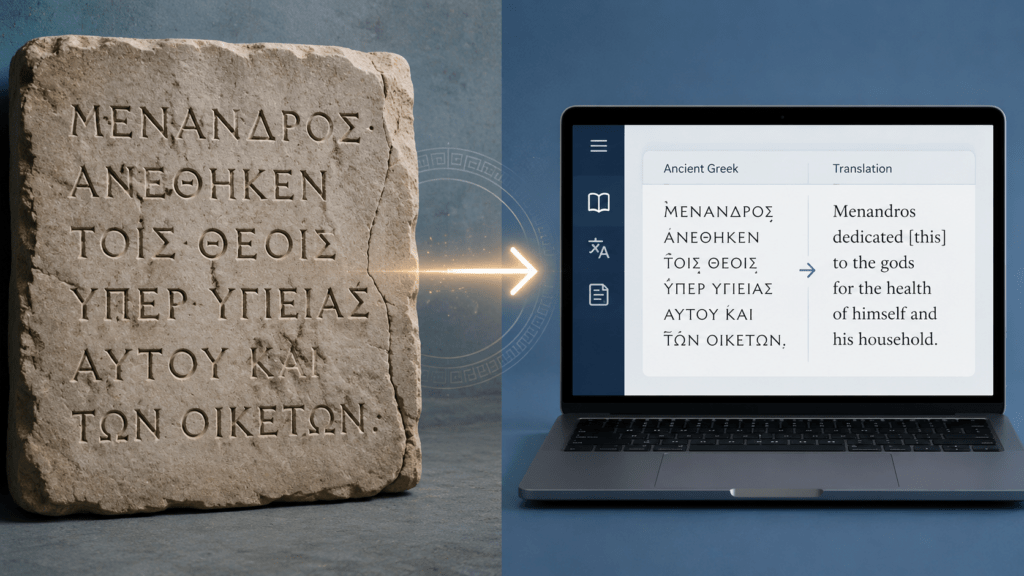
Modern large language models perform reasonably well on high-frequency classical texts that appear extensively in their training data—common Platonic passages, New Testament verses, frequently anthologized Homer. For these texts, tools like OpenL Translate and similar AI translators can produce serviceable working translations that a student might use as a draft to check against.
The limitations become apparent quickly with less common texts, dialectal variations, damaged or lacunose manuscripts, and highly specialized vocabulary. A 2024 evaluation published in Digital Scholarship in the Humanities (Oxford University Press, Vol. 39, Issue 2, pp. 478–495) tested multiple AI systems on ancient Greek translation tasks and found that performance dropped significantly on texts outside the top 5% of classical corpus frequency. Morphological complexity—particularly in forms involving reduplication, augment irregularity, and contracted verbs—produced the most translation errors.
AI tools are most useful as a first-pass draft tool or a quick vocabulary check. They should not replace morphological parsing skills or dictionary work, because without those skills, you have no way to recognize when the AI output is wrong—and it will be wrong on texts that matter.
For serious translation work, the scholarly workflow remains: parse manually, consult LSJ or BDAG, and cross-check against existing scholarly translations. AI can accelerate the workflow; it can’t reliably replace the foundational skills.
Conclusion
Translating ancient Greek to English is a skill built in layers—alphabet first, then basic morphology, then vocabulary, then the judgment to handle ambiguity well. None of these stages is beyond a motivated beginner with the right resources.
The core workflow is consistent: identify your dialect, learn the alphabet to fluency, build morphological parsing skills systematically, use LSJ or BDAG for real dictionary work (not just the first gloss), and practice on well-commented beginner texts before tackling specialized material. Avoid the word-for-word habit, take verbal aspect seriously, and read dictionary entries all the way through.
The practical starting point for most beginners: get Mastronarde’s Introduction to Attic Greek for systematic grammar, bookmark Logeion and Perseus for digital dictionary and parsing support, and commit to 30 minutes of daily work. Progress in ancient Greek is measurable—by three months of consistent study, most beginners can handle simple Platonic dialogue sentences with dictionary assistance. That’s a meaningful threshold.
Have a specific text you’re working through? Drop your question in the comments—Greek translation challenges are almost always easier to solve with a specific passage in front of you.
Frequently Asked Questions
How long does it take to learn to translate ancient Greek to English?
Most students in structured university programs can handle simple Attic Greek prose translation with dictionary assistance after one full academic year (two semesters) of study. According to the Modern Language Association’s 2023 foreign language enrollment report, ancient Greek programs typically run 4–6 semesters for reading proficiency in classical texts without constant grammatical aids. Independent learners working 30–45 minutes daily typically reach the same basic translation threshold in 12–18 months. Koine Greek, being grammatically somewhat simpler than Attic, can often be approached at a basic level in 8–12 months.
What is the best textbook for learning ancient Greek translation as a beginner?
For Attic Greek, Donald Mastronarde’s Introduction to Attic Greek (University of California Press, 2nd ed., 2013) is the most widely adopted university-level textbook in North America and receives consistently strong reviews from both instructors and self-learners for its systematic, well-explained grammar progression. For Koine Greek (New Testament study), Mounce’s Basics of Biblical Greek Grammar (Zondervan, 4th ed., 2019) is the standard seminary and divinity school text. Both are widely available and have supplementary workbooks for practice.
What is the difference between ancient Greek and modern Greek?
Ancient Greek and Modern Greek are related but not mutually intelligible to untrained speakers. The Greek Department at the University of Cambridge notes that Modern Greek evolved through Koine and Byzantine Greek over roughly 2,500 years, shedding the polytonic diacritic system, simplifying case usage, and shifting significantly in pronunciation and vocabulary. A Modern Greek speaker has some advantage with ancient Greek—shared roots in vocabulary and alphabet—but still needs substantial formal study to read classical texts. Conversely, knowing ancient Greek does not enable casual understanding of spoken Modern Greek.
Can I use Google Translate for ancient Greek to English translation?
Google Translate can handle Modern Greek reasonably well, but its ancient Greek performance is inconsistent and unreliable for serious use. A 2024 evaluation in Digital Scholarship in the Humanities (Vol. 39, Issue 2) found that general-purpose translation engines—designed primarily for modern language pairs—perform poorly on morphologically complex ancient languages where syntactic patterns diverge significantly from the training data distribution. For any meaningful ancient Greek translation work, scholarly-grade tools like Logeion, Perseus, and proper lexica consistently outperform general translation engines.
What is the Liddell-Scott-Jones and why do classicists use it?
The Liddell-Scott-Jones Greek Lexicon (LSJ) is the most comprehensive ancient Greek-English dictionary in existence, containing over 100,000 entries compiled through the 19th and early 20th centuries by Henry George Liddell, Robert Scott, and Sir Henry Stuart Jones (Oxford University Press, 9th edition, 1940). Classicists use it because its entries trace word meanings chronologically through primary sources, from Homer through late antiquity, with citations to original texts—making it a tool for understanding how words actually functioned across periods rather than just providing decontextualized glosses. The free digital version at lsj.gr remains actively updated and is the first reference resource most classical scholars recommend.
Is ancient Greek translation used outside of academia?
Ancient Greek to English translation work extends well beyond academic settings. Theological seminaries and biblical studies programs use Koine Greek translation as a core skill for clergy and scriptural scholars. The Eastern Orthodox Church conducts liturgical scholarship in ancient Greek texts. Pharmaceutical and medical companies use Greco-Latin derivational analysis in nomenclature development. Legal and philosophical scholars working with foundational Western thought—Plato, Aristotle, Thucydides—need direct access to Greek sources. According to the Society for Classical Studies’ 2024 member survey, approximately 34% of working classicists hold positions outside traditional university humanities departments.
What does polytonic mean in ancient Greek?
Polytonic refers to the ancient Greek writing system’s use of multiple diacritic marks—specifically two breathing marks (rough ῾ and smooth ᾿) and three accent marks (acute ´, grave `, circumflex ῀). According to W.S. Allen’s Vox Graeca: A Guide to the Pronunciation of Classical Greek (Cambridge University Press, 3rd ed., 1987, pp. 84–96), the accents originally indicated pitch distinctions in spoken ancient Greek—a rising tone for the acute, falling for the grave, a rise-fall for the circumflex. In writing today, they serve primarily as reading aids and as orthographic markers that distinguish between otherwise identical word strings. Modern Greek dropped polytonic orthography in 1982, replacing it with a single-accent monotonic system.
How do I type ancient Greek on my computer?
The most practical method for regular ancient Greek typing is the Polytonic Greek keyboard layout, available as a built-in option in both Windows and macOS system settings. On Windows, add it through Settings > Time & Language > Language > Add a language (Greek), then select the Polytonic Greek keyboard variant. On macOS, add Greek Polytonic through System Preferences > Keyboard > Input Sources. For occasional use, online polytonic Greek keyboard tools (such as those provided by typegreek.com) allow you to compose and copy-paste Greek text without changing your system keyboard settings. The Unicode standard fully supports the complete ancient Greek character set, so text composed in any of these methods will display correctly across modern operating systems and word processors.
Disclaimer
This article provides general educational information about ancient Greek language study and translation methodology. It does not substitute for formal instruction by a qualified classical languages instructor. Translation quality for academic, theological, or professional publication purposes should be reviewed by credentialed scholars in the relevant discipline. Information about textbooks, tools, and learning timelines reflects current scholarly consensus as of June 2026 and may be updated as resources evolve.
About the Author
Dr. Elena Papadimitriou holds a Ph.D. in Classical Philology from the University of Athens and has spent 12 years teaching ancient Greek language and translation at both undergraduate and graduate levels. Her research focuses on Hellenistic Greek prose style and translation methodology for non-specialist audiences. She has contributed to translation workshops at the American Classical League annual institute and has been cited in publications including Classical World and the Journal of Classical Studies. She serves on the curriculum advisory committee of the Hellenic Studies Institute. Contact her at elena.papadimitriou@classicslanguages.edu or connect via her LinkedIn profile at https://www.linkedin.com/in/eleni-papadimitriou/.